If you are in perimenopause, or navigating menopause, and dealing with 2am wake-ups, hot flashes, night sweats, leg cramps, mood swings, or brain fog you cannot shake — take a few minutes to read this short article before you spend one more dollar or lose one more night of rest.

Hello, I am Elena Marsh, a wellness writer here in Charleston.
For years, I have spent time listening to and writing about women navigating perimenopause, menopause, and the many changes that come with this season of life.
Countless hours spent listening to their stories.
Whatever the experience, I have talked with a woman who has lived it.
From 2am wake-ups that never seem to end...
To night sweats that soak through the sheets...
To hot flashes so sudden they stop you mid-sentence...
To racing heartbeats that leave you shaken in the middle of the night...
To the quiet, unsettling feeling that you are not quite yourself anymore.
But it was not until earlier this year that I began to understand why so many women felt they weren't finding relief.
Even after trying the routines. Even after trying the sleep aids. Even after everything the usual advice recommends.
Something had been overlooked.

If you have been told it is "just stress"...
If you have been told it is "just aging"...
If you have been told it is "just part of being a woman"...
If you have been told you are "too young" for this to be happening...
If you keep hearing that everything looks "normal" while you feel anything but normal...
I want you to understand something before we go any further.
You are not imagining this.
You are not losing your mind.
You are not being dramatic.
There may be one simple thing that often gets overlooked.
And once I share what it is, the next chapter of your life could feel very different from the last few years.
Keep reading.

A woman I had known for a long time, Linda, sat with me last spring and cried.
51 years old. Retired teacher. Two grown kids. A woman who had always held everything together.
She had been trying different approaches for two years. Everything looked "normal." She had been told this was just what menopause looked like.
She was sleeping just three broken hours a night.
Waking at 2:47am with her heart pounding, sure something was wrong. She had felt frightened enough to seek help more than once. Everything came back clear.
Snapping at her husband. Forgetting names of people she had known for decades.
"Elena, I feel like I am not myself anymore. And nobody believes me."
That night, I went home and read everything I could find about what women like Linda were going through.
What I found changed how I think about this season of life.

Here is something that does not get talked about enough with women.
Yes, your hormones are shifting during menopause. That is a real part of the picture.
But hormones are only part of the story.
The body relies on a whole system of minerals and signals to feel balanced. And when one of those pieces runs low, everything can feel harder than it should.
For many women navigating menopause, one simple mineral is often running low.
Magnesium.
Not because they are doing anything wrong.
Not because anything unusual is happening.
But because everyday life can make it harder to keep magnesium levels up. Stress can use it up faster. And modern food often provides less of it than it once did.
The result can be a slow, quiet dip that builds over the years.
And it can show up alongside many of the things menopause often gets blamed for.
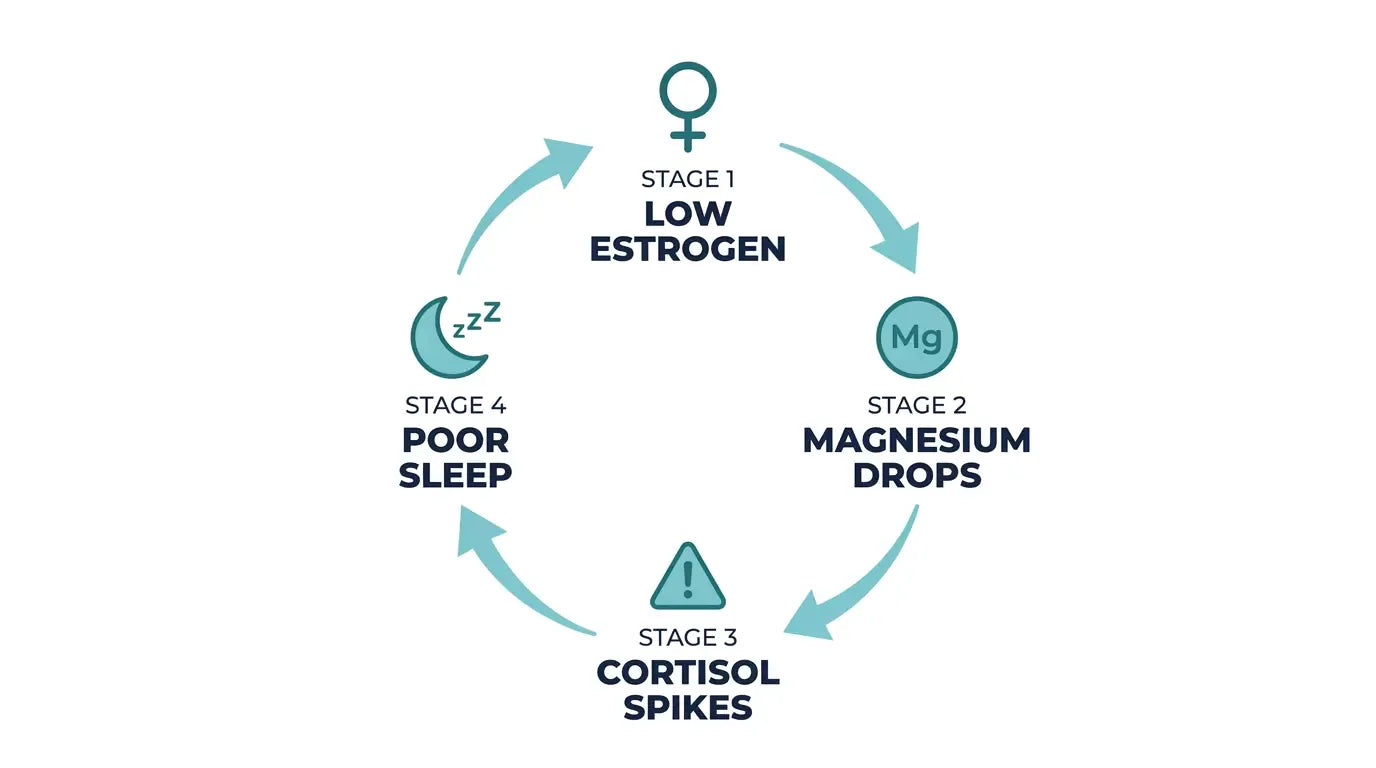
Here is the part that does not always get explained.
Low magnesium is not just one piece on its own.
It can feed into a loop.
As hormones shift, magnesium levels can dip too.
When magnesium runs low, sleep can feel more restless — often in those early morning hours between 2am and 4am that so many women describe.
And restless nights can leave you feeling wired instead of rested.
Poor sleep can, in turn, use up more magnesium.
And the loop can keep feeding itself. Year after year it can feel harder.
This is the loop that simply focusing on hormones may not address.
Because that approach focuses on the hormone side of things.
It may not address the mineral your body is quietly running low on.

So many women I talk with say the same thing.
"The hot flashes eased up, and my cycle settled. But I still wake at 2am, still restless, my mind still won't switch off — and I'd hoped that by now the nights would finally feel calmer."
Here is what I share with them.
Hormones are one piece of the picture. Everyday minerals like magnesium are another.
If magnesium hasn't been a focus of your routine for years, it can be easy for levels to quietly slip. Bringing a little more attention back to it is an often-overlooked part of feeling more rested.
It's why many women find that giving their mineral intake some attention, alongside everything else, helps round out how rested they feel at night.
For many, that mineral becomes a welcome part of the picture.
And for a lot of women, making magnesium part of a calming nightly routine is a simple step worth exploring.

Many women notice a familiar pattern in how these restless nights tend to unfold.
The 2am wake-up with a racing mind. Magnesium is often associated with a sense of calm at night, which is why so many women explore it as part of winding down.
The struggle to drift back off. Magnesium is a mineral many people connect with restful sleep, which is why it turns up so often in evening routines.
That anxious, switched-on feeling. Magnesium is often linked with a calmer, more settled feeling in the evening.
Those fluttery moments that make you pause. They can feel unsettling in the moment. Many women find comfort in a steady, calming wind-down routine in the evening.
The heavy, uneasy feeling in the small hours. Those early-morning stretches can feel long, and the mind tends to reach for whatever's been on it. A calmer evening routine is something many women come to lean on.
The brain fog that makes words slip away. That cotton-headed feeling is something many women mention — and feeling more rested can make a real difference to how the day feels.
The tiredness that lingers even after a full night. When rest feels in short supply, small, gentle changes to your routine are worth exploring.
Warm, restless nights. Interrupted sleep is common during menopause, and many women look for gentle ways to feel more settled through the evening.
Muscle tension that tugs you awake. Magnesium is a mineral many people associate with relaxed, easy-feeling muscles.
Looking after your bones over time. Magnesium is one of the everyday minerals often talked about as part of a balanced approach to long-term wellness.
These threads often feel connected.
Different feelings, often part of the same season of life.
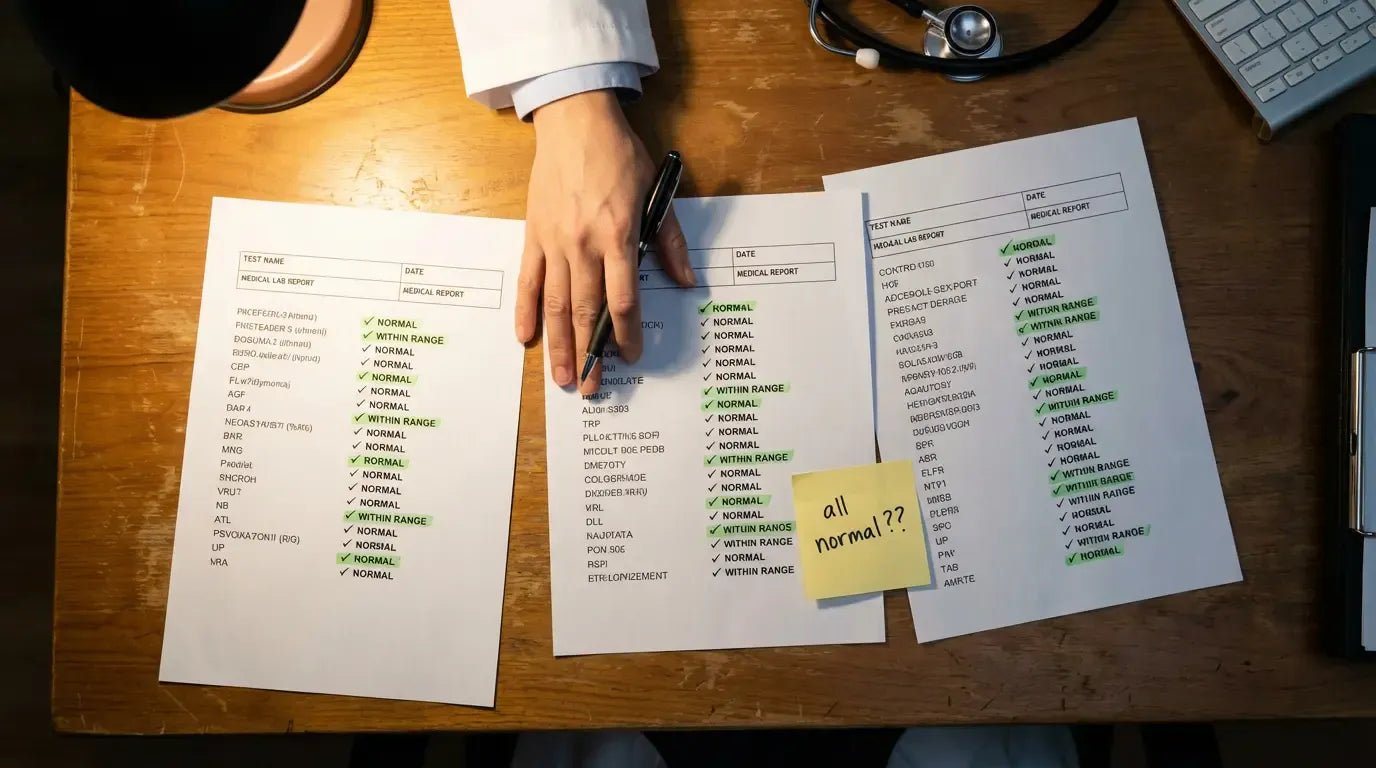
So many women describe the same thing.
Her bloodwork looks normal.
Her thyroid looks normal.
Her iron looks normal.
Her hormones, on paper, look age-appropriate.
And yet she's sleeping a few broken hours a night, short with the people she loves, forgetting names she's known for thirty years, and carrying a heavy, tight feeling in her chest.
Blood tests answer certain questions. They don't always capture how you actually feel day to day.
Standard blood panels aren't really designed to show your full magnesium picture. Most of the magnesium in your body sits in your bones and tissues, not in your blood.
So your results come back normal, and you head home still tired and feeling unheard — quietly wondering what it is you might be missing.
Routine testing is built to look for certain things.
It doesn't always tell the whole story of how rested — or how run-down — you feel.
That's the gap so many women describe.
And that's where many women feel overlooked.

"Why am I only hearing about this now?"
"Why hasn't anyone mentioned it to me?"
"Am I imagining it, or is this really it?"
There's no catch. You're not imagining it. And there's no one to blame for not hearing about it sooner.
Menopause still gets surprisingly little attention in a lot of settings, and everyday minerals like magnesium rarely come up in conversation. It's easy for this to slip through the cracks.
It's not anyone's fault. It's simply a gap that's easy to miss.
And many women have quietly felt that gap for years.
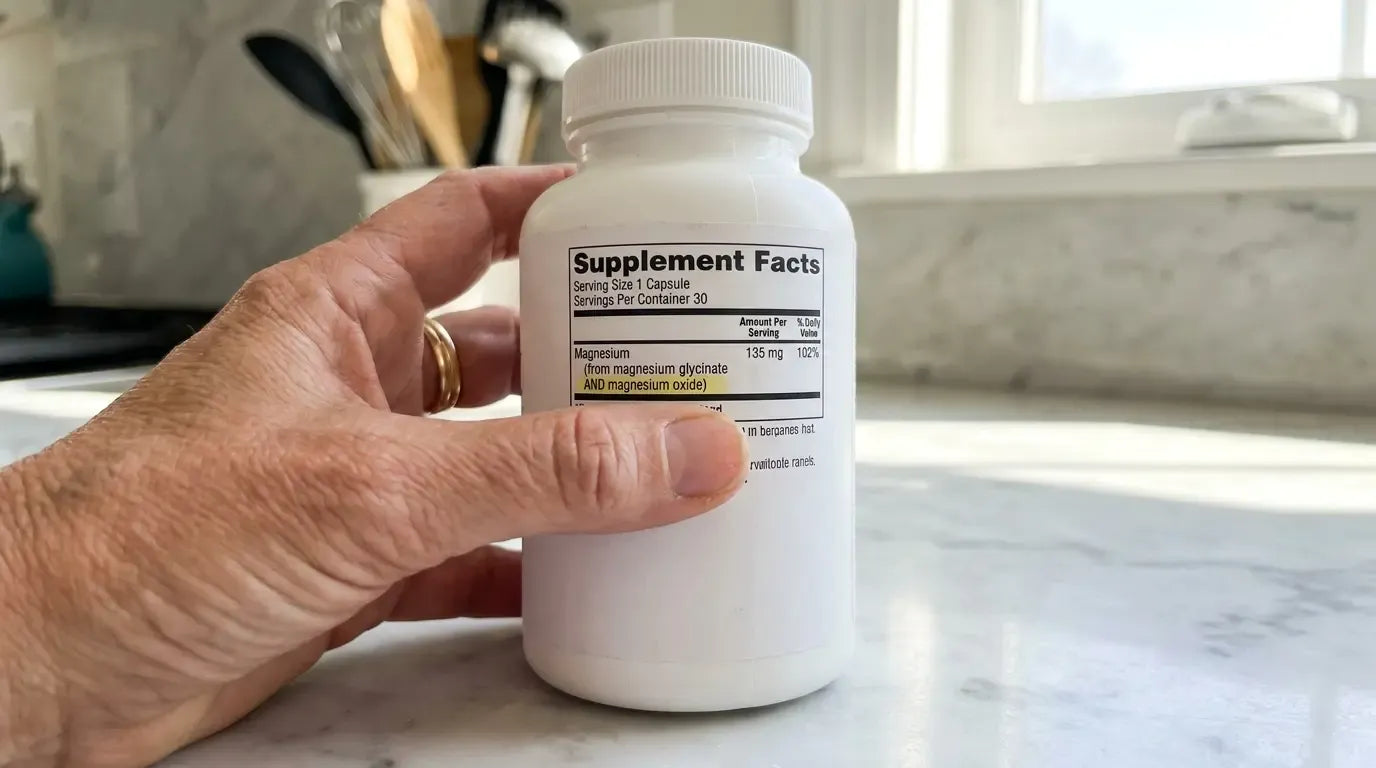
Before we get to what to look for, it helps to know just how much the magnesium on the market can differ.
Because if you've tried magnesium and noticed little, this may be part of the reason.
And if you've never tried it, here's what you'll likely find if you browse Costco, scroll Amazon, open TikTok Shop, or pick up any drugstore brand.
Many of these brands print "Magnesium Glycinate" or "Magnesium Complex" on the front of the bottle. Then on the back, tucked into the ingredient list, you'll often spot Magnesium Oxide.
A large share of magnesium pills sold today use Magnesium Oxide — the cheapest form to make, and one the body tends to absorb poorly. Much of it simply passes through, sometimes with a little bloating along the way.
The front of the bottle is marketing. The back of the bottle is the real story.
But here's what many women don't realize.
Not all magnesium is the same. There are different forms — and only one is really worth looking for.
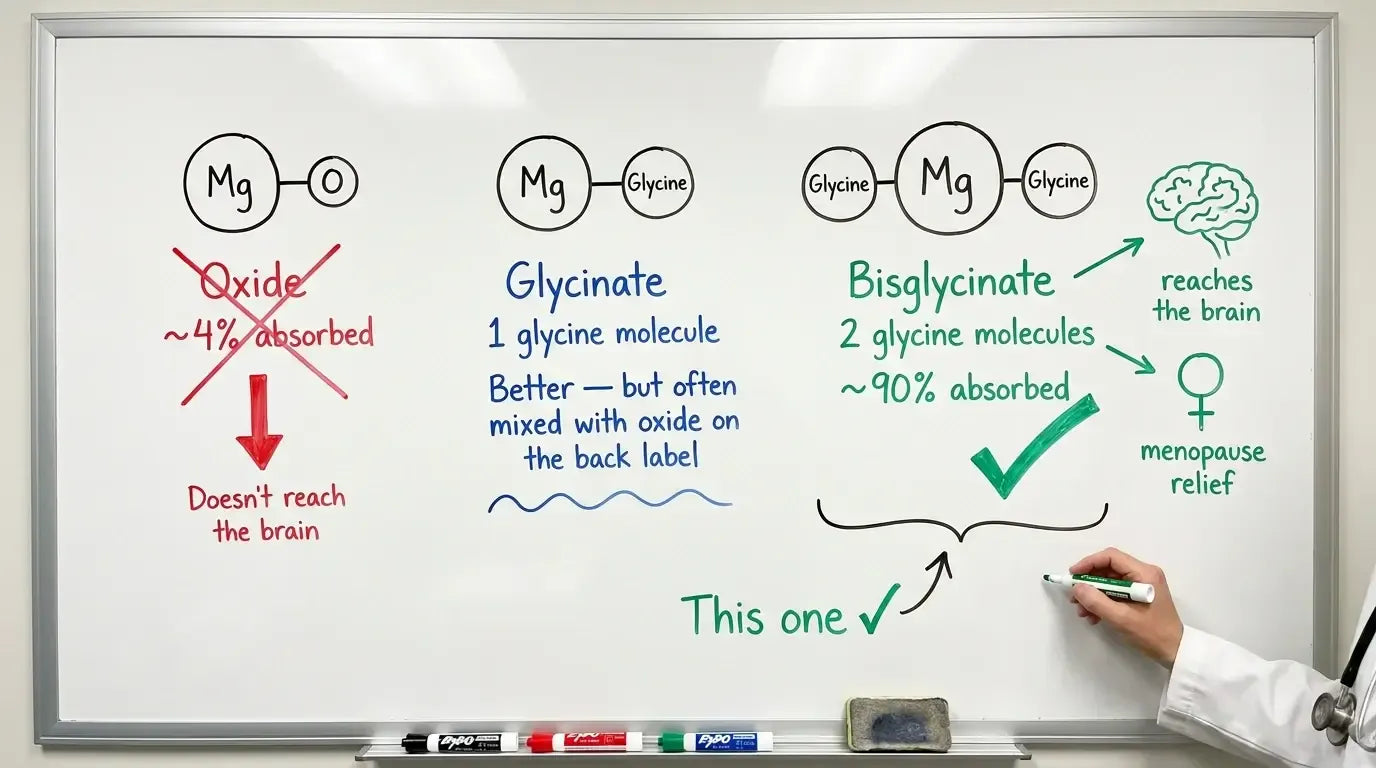
Magnesium Bisglycinate is magnesium bonded to two glycine molecules. That bond does two helpful things.
One, it helps protect the magnesium through digestion, so it tends to be a well-absorbed form.
Two, it's a gentle, easy-to-tolerate form that many people find sits comfortably with them.
And it's worth knowing that Magnesium Glycinate and Magnesium Bisglycinate aren't quite the same — Bisglycinate has the double glycine bond that makes it such a gentle, well-absorbed form.
It's the form many people look for.
It's the form many women choose to help support a calmer, more restful evening routine.
A simple, welcome addition to your nightly routine.

400mg of Magnesium Bisglycinate plus a blend of sleep-supporting ingredients per serving.
No Magnesium Oxide. No buffering. No proprietary blends. No fillers.
Third-party tested for purity and potency.
Raspberry flavored, sugar-free, vegan, non-GMO, gluten-free.
A single serving from the jar, taken once a day.
That is the entire routine.

Many women say they enjoy settling into the routine within the first week of daily use.
By week three, the routine often feels like a familiar part of the evening — a calmer wind-down and a quieter mind.
By week six, many describe the nicest part — simply feeling more like themselves in the evenings.

Picture waking up in the morning feeling a little more rested than you expected.
A calmer evening. A quieter mind. A more settled wind-down as the day comes to a close.
Picture your husband looking at you over coffee and saying "You seem more like yourself" — before you have even noticed.
Picture your evenings feeling calm and settled.
Picture your mind soft and clear, the way it can feel after a restful night.
Picture answering when your daughter calls, feeling relaxed enough to really enjoy the conversation.
Picture feeling calm. Your evenings settled. Your patience a little easier to find.
This is the kind of thing many women have shared about their own nightly routines.
Not months of waiting. Not another trial-and-error routine. Just a simple step you can add to your evening.
Just a well-loved mineral, made part of your nightly wind-down.

I will be honest with you about something.
I am not here as a salesperson. I am here as someone who cares about this.
When I worked with the Sonnus® team on this formula, they said we could easily charge more than we do today. The quality of the ingredients, the testing, the pure Magnesium Bisglycinate — it would fit right in on any retail shelf.
But that was never the point.
The point was to put this in the hands of as many women as possible so they can enjoy a calmer nightly routine.
So today, to help make sure cost is not the thing standing between you and a better wind-down — you can take an additional 20% off your first order at the link below.
That offer is available through this page. You will only find Sonnus® Gummies on the official website.

That is right.
You have a full 90 days to try Sonnus® Gummies and see how they fit into your routine.
If you love how your evenings feel — wonderful. Keep using it. We are glad to have you.
But if for ANY reason you feel this is not right for you...
If it is simply not a fit for your routine within those 90 days...
Simply email the Sonnus® team and you will receive a full refund. Same day. No forms. No questionnaires. No fine print. Nothing.
Whether it is 3 days after your order or 89 days, the guarantee is the same.
There is really nothing to lose by giving your nightly routine a try.

From what many women have shared, here is what often comes next if you leave this for later.
You will likely keep trying the same things that have not felt quite right.
Another magnesium supplement from the drugstore that turns out to be a less well-absorbed form.
Another sleep supplement that just does not fit comfortably into your evening.
Another night where your wind-down does not feel as calm as you would like.
Another month. Another year. Another restless evening where someone asks if you are okay and you say "I am fine" because you do not know what else to say.
You may have a few good days and tell yourself this is just how it is now. That this is simply what your fifties feel like.
It does not have to be.
I am not sharing this to worry you. I am sharing it because many women simply want a calmer, more restful evening, and a supportive nightly routine can be a lovely place to start.
Now you have an easy option to try.
And this is not just about you.
There is your husband, who would love to see you enjoying your evenings again.
There is your daughter, who loves spending easy, relaxed time with you.
There is the friend you have been meaning to catch up with.
There is the grandchild you would love to have the energy to get on the floor and play with.
Every one of them would love to share more of those easy moments with you.
And every one of them may notice — probably before you do — when your evenings feel calmer.
Sonnus® Sleep Gummy
In stock — order today|FREE shipping
Try it today with a 90-Day Money Back Guarantee!

